STARTUP-PLATFORM·Startup

TrendStarz - Influencer & Brand Collaboration Platform

Building a Creator Marketplace for India

TrendStarz home page with entry points for brands, influencers and photographers

Executive Summary

Overview

TrendStarz is a marketplace where Indian brands hire influencers and photographers for campaigns. The money is held safely until the work is posted, so both sides can trust each other. I designed, built and run it end to end, from the first screen to payouts and admin tools.

Creators350+Registered influencers and photographers
Brands25+Registered on the platform
Paid out₹1,10,402Released to creators' UPI

Market Context

The Problem

Most brand–creator deals in India happen over Instagram DMs and WhatsApp, with nothing that protects either side. I saw the same five problems again and again.

01

Trust about money

Creators worry they won't be paid after posting. Brands worry about paying upfront and getting nothing back.

02

No-shows

A creator accepts, the product ships, and the post never goes up. Nobody keeps track of it.

03

Unclear briefs

Deliverables, scripts and posting dates live in chat threads and get disputed later.

04

Hard to judge creators

Follower counts say little. Small brands can't tell a reliable creator from an inflated one.

05

Photographers left out

Most platforms only match brands with influencers. Influencers who need a photographer, and photographers who need talent, have no organised way to find each other.

Users

Who It's For

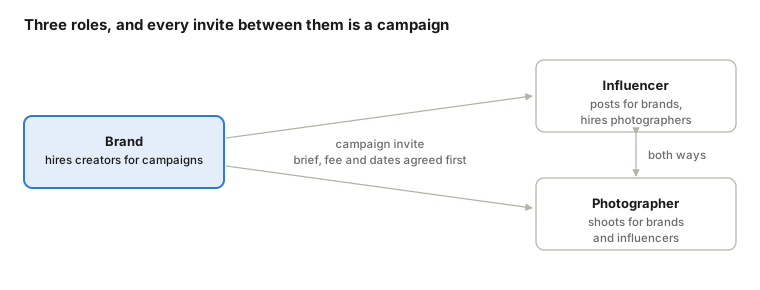
Three roles share one product, and each can send or receive a campaign.

Brands invite influencers and photographers; influencers and photographers can also invite each other. Every invite is a campaign.

Brands

What they need

Reliable creators, proof of posting, no wasted spend

What they get

Search by niche and city, held payments, posting tracking, refunds when a creator doesn't post

Influencers

What they need

Paid work, guaranteed payment, a credible profile

What they get

Campaign invites, UPI payouts, a TrendScore that shows quality beyond followers

Photographers

What they need

Shoots with brands and influencers, a portfolio

What they get

Invites from brands and influencers, a portfolio profile, file delivery by Drive link

Product

The Solution

The whole deal now happens in one place: the brief, the payment, proof of posting and the payout. Every invite is a campaign: the brief, deliverables and dates are agreed before anyone commits.

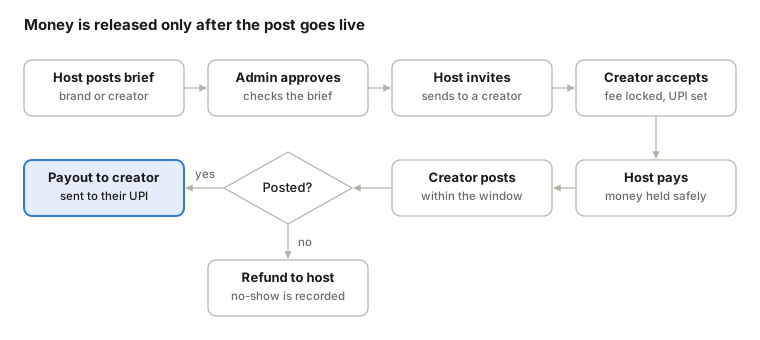
Campaign flow: host posts a brief, admin approves, host invites, creator accepts, host pays and the money is held. If the creator posts within the window the payout goes to their UPI; if not, the host is refunded and the no-show is recorded.

Four campaign types

Paid, Product (barter), Location visit, and Product + Paid. Each type has its own rules for shipping, visits and limits.

Held payments

The host pays through Razorpay when confirming a creator. The money is released to the creator's UPI only after the post is live. If the creator doesn't post, the host gets a refund.

Posting window

Each campaign has a post date with a fixed grace period. The platform marks posts as on time, late or missed, and shows no-shows to the host.

TrendScore

A profile quality score built from engagement, consistency and completeness, so brands can judge creators beyond follower count.

Premium plans

Monthly campaign and invite slots, lower commission, and creator membership, all with clear limits.

Admin console

Campaign approval, disputes, refunds, payout queues, profile verification and a data-health page that checks the system every night.

Notifications

Email, push and WhatsApp messages that open the exact invite or payment they refer to.
Live Product

Key Screens

Real screens from the live product, on desktop and phone.

01

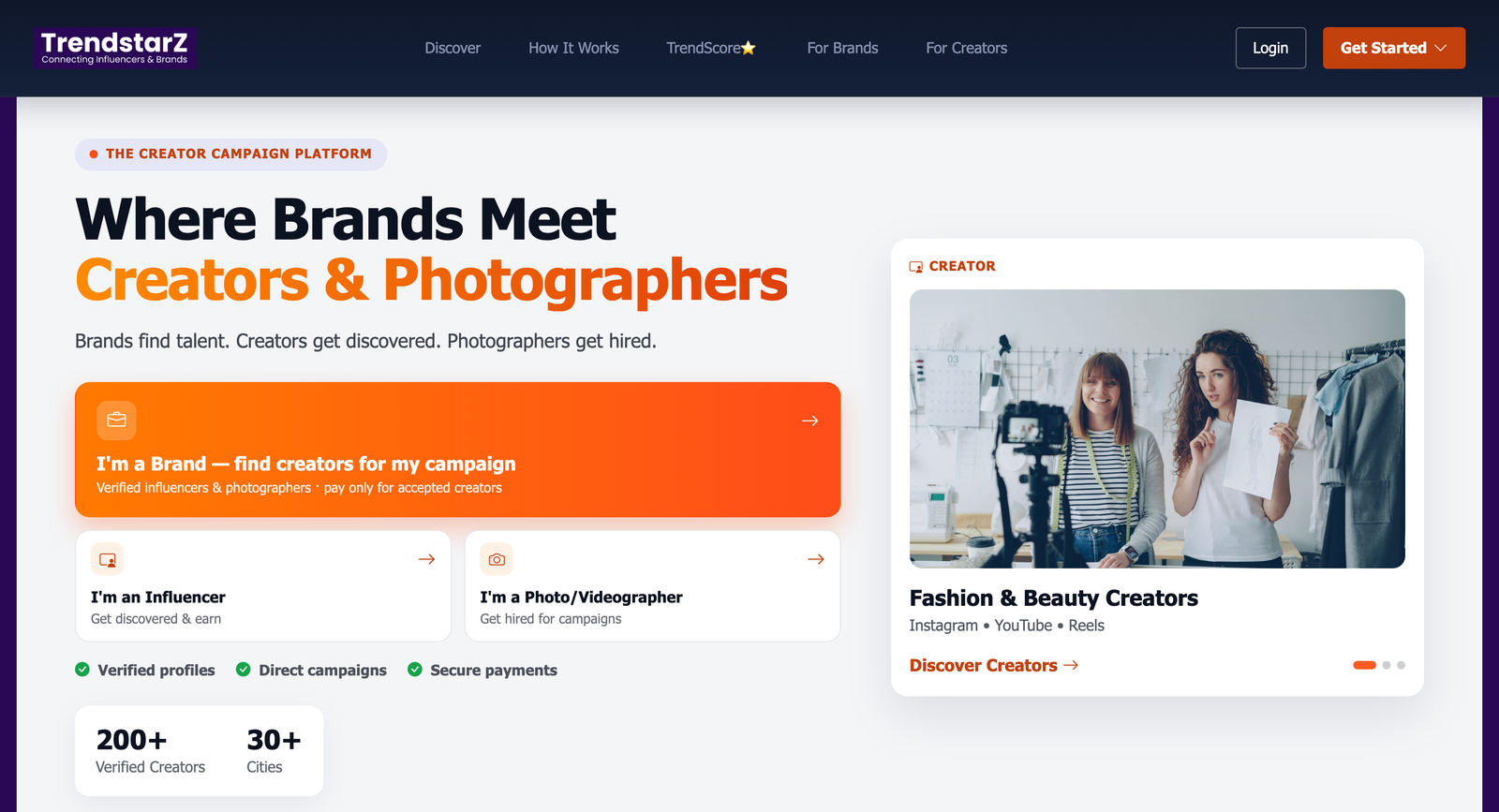
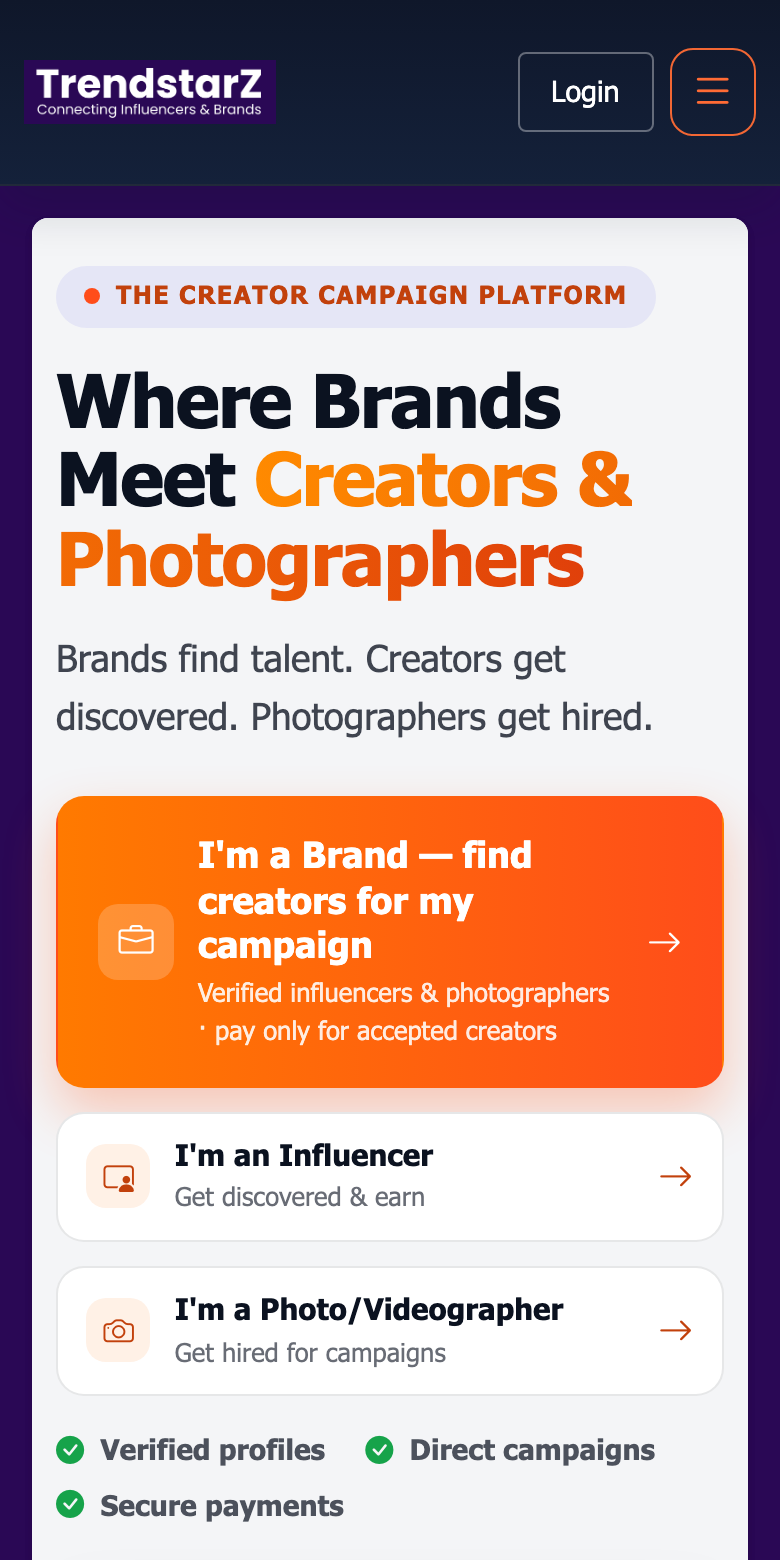
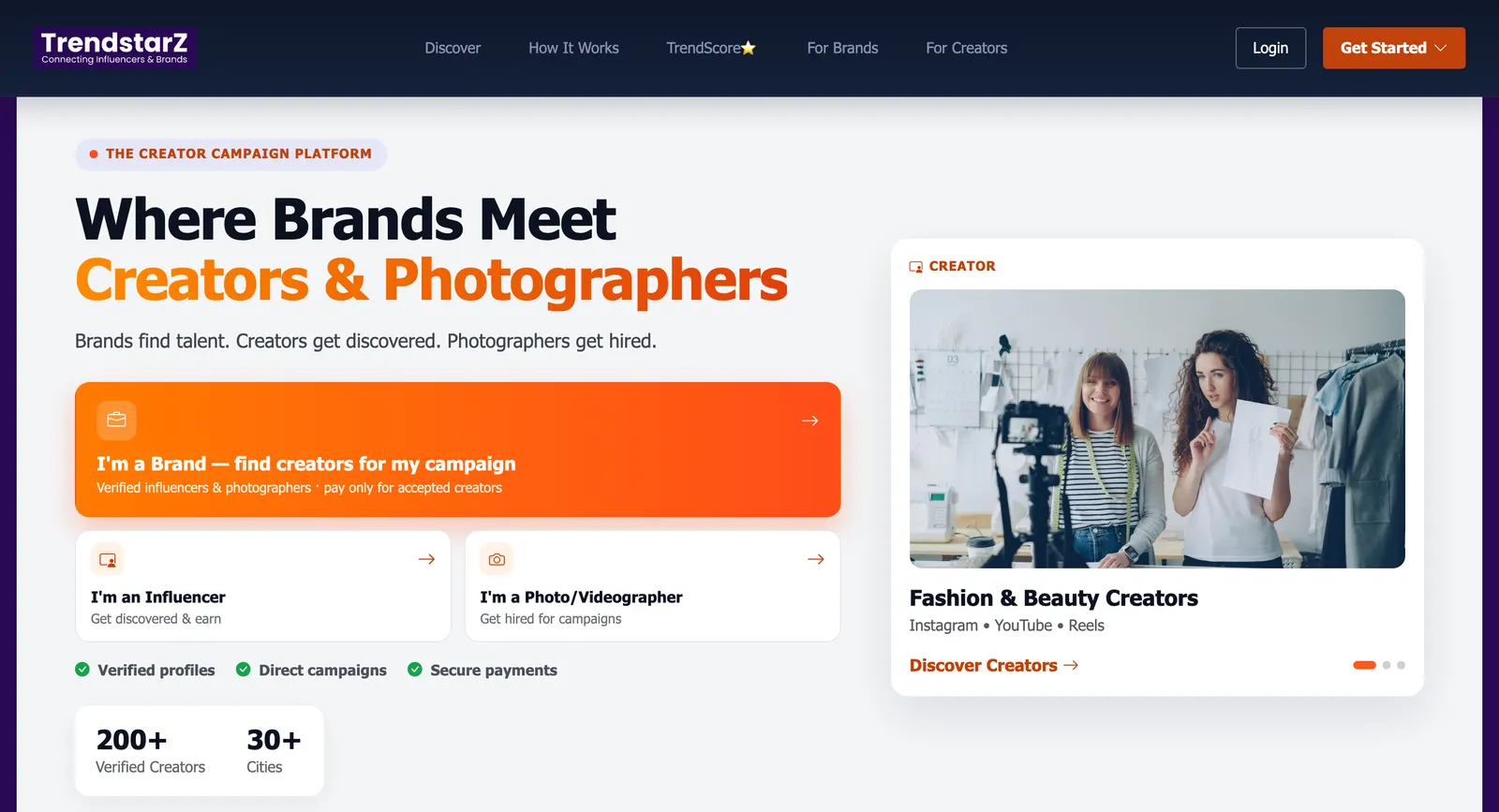
One entry point, three roles

The first screen asks who you are. Brands get the main action, and influencers and photographers each get their own path, so nobody starts on a page written for someone else.

TrendStarz home page with separate entry cards for brands, influencers and photo/videographers (desktop)
TrendStarz home page with separate entry cards for brands, influencers and photo/videographers (mobile)
02

Discovery beyond follower count

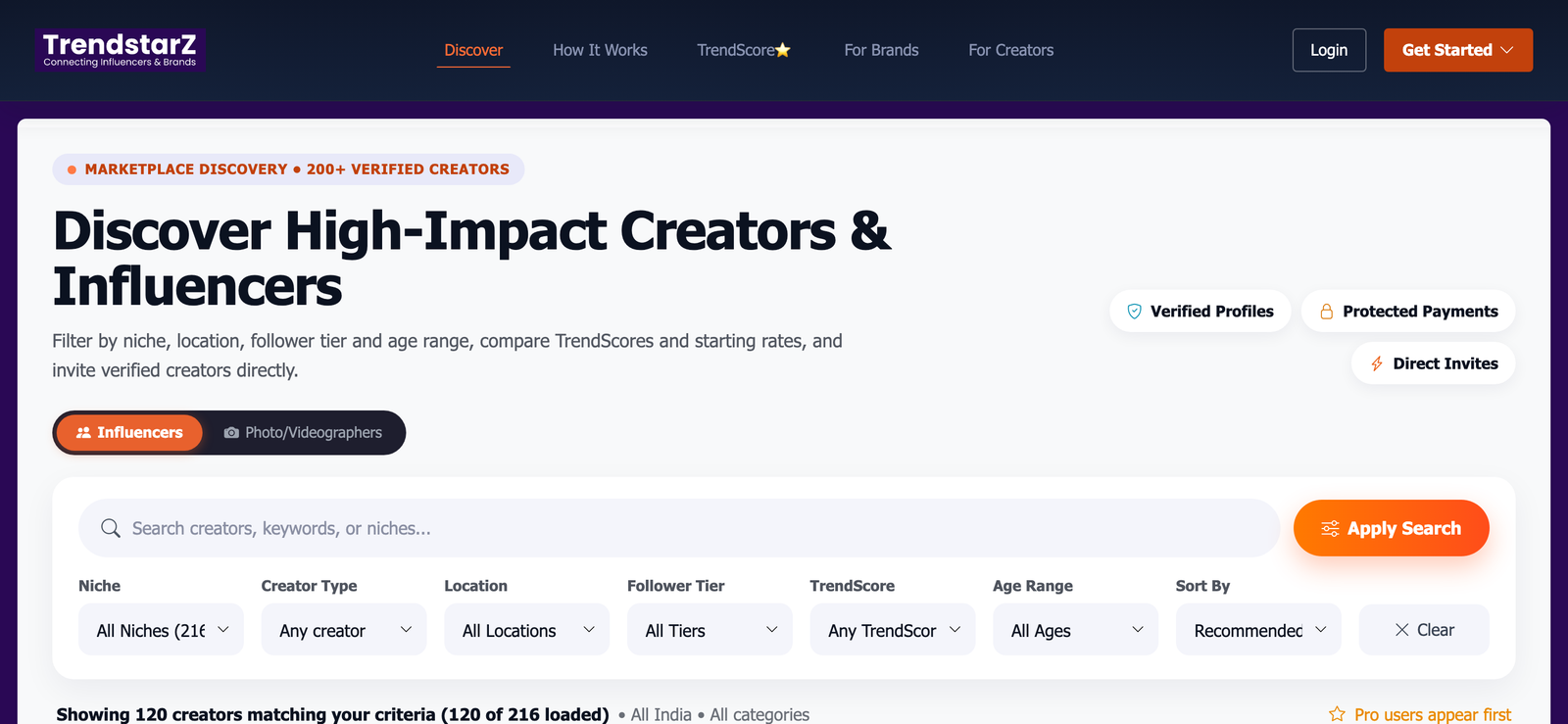
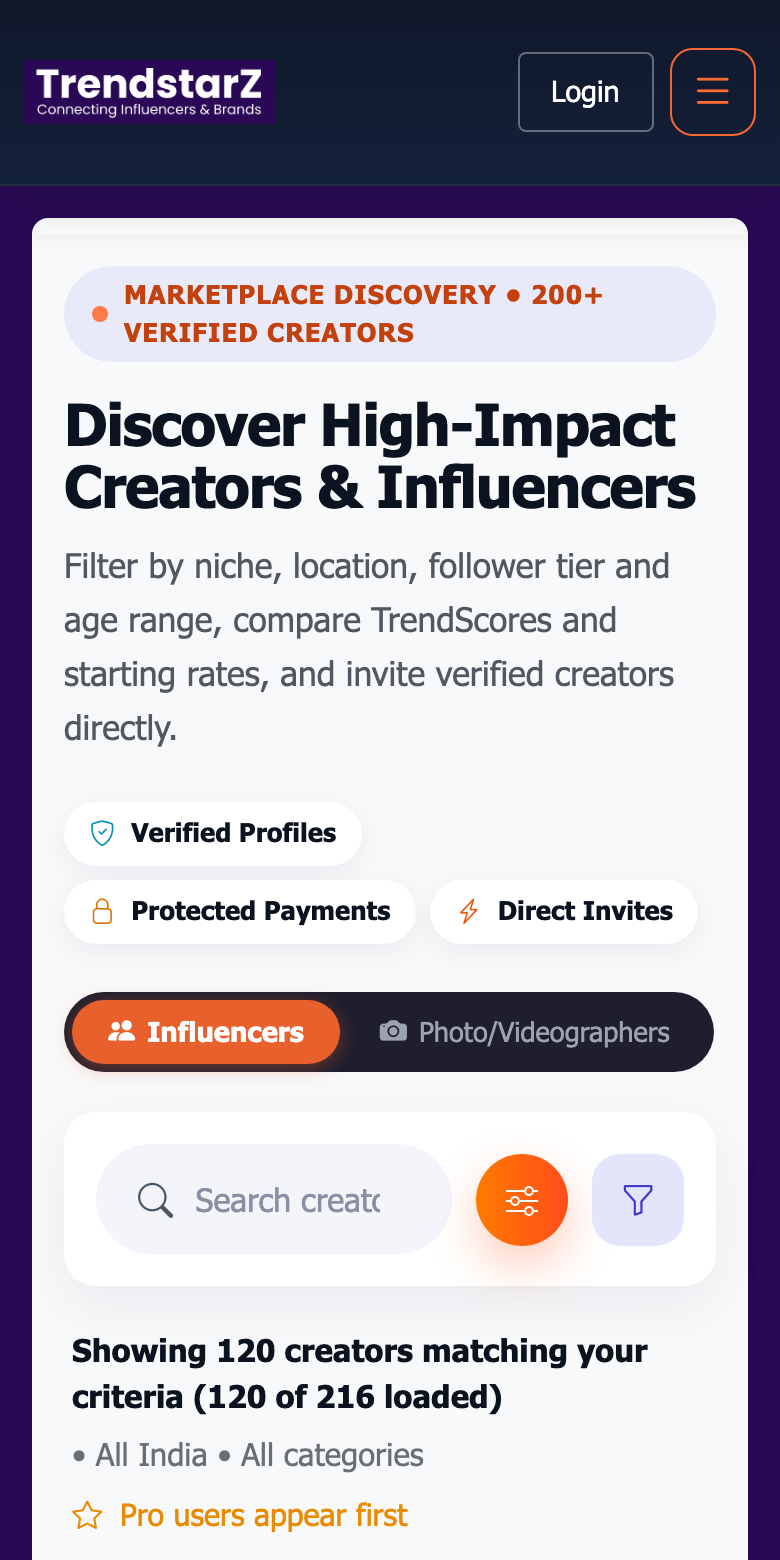
Brands filter by niche, creator type, city, follower tier, TrendScore and age, and compare starting rates before inviting anyone. On phones the filters fold into one button so the results stay in view.

Creator discovery page with search and filters for niche, location, follower tier, TrendScore and age (desktop)
Creator discovery page with search and filters for niche, location, follower tier, TrendScore and age (mobile)
03

TrendScore shows what to improve

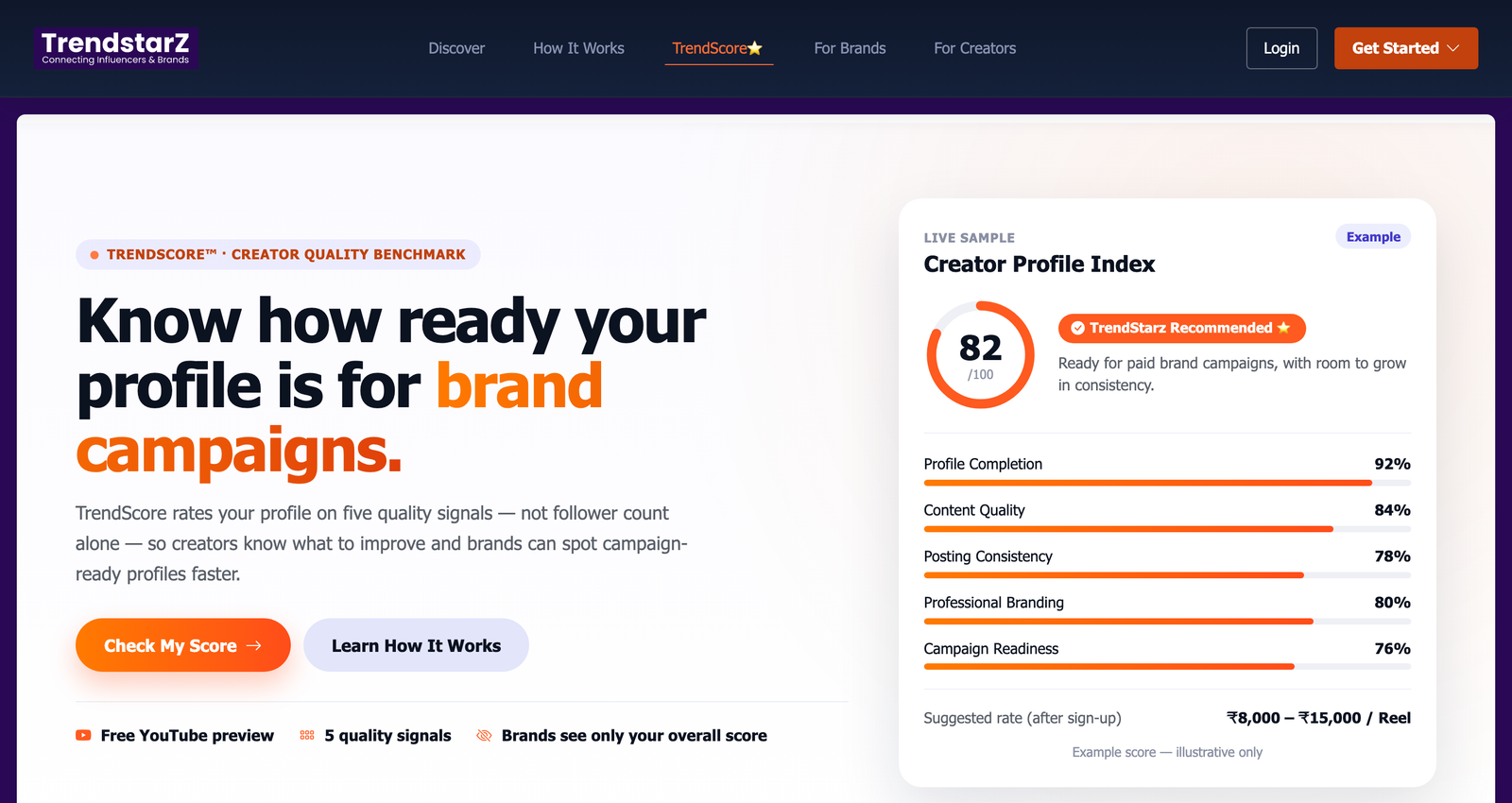
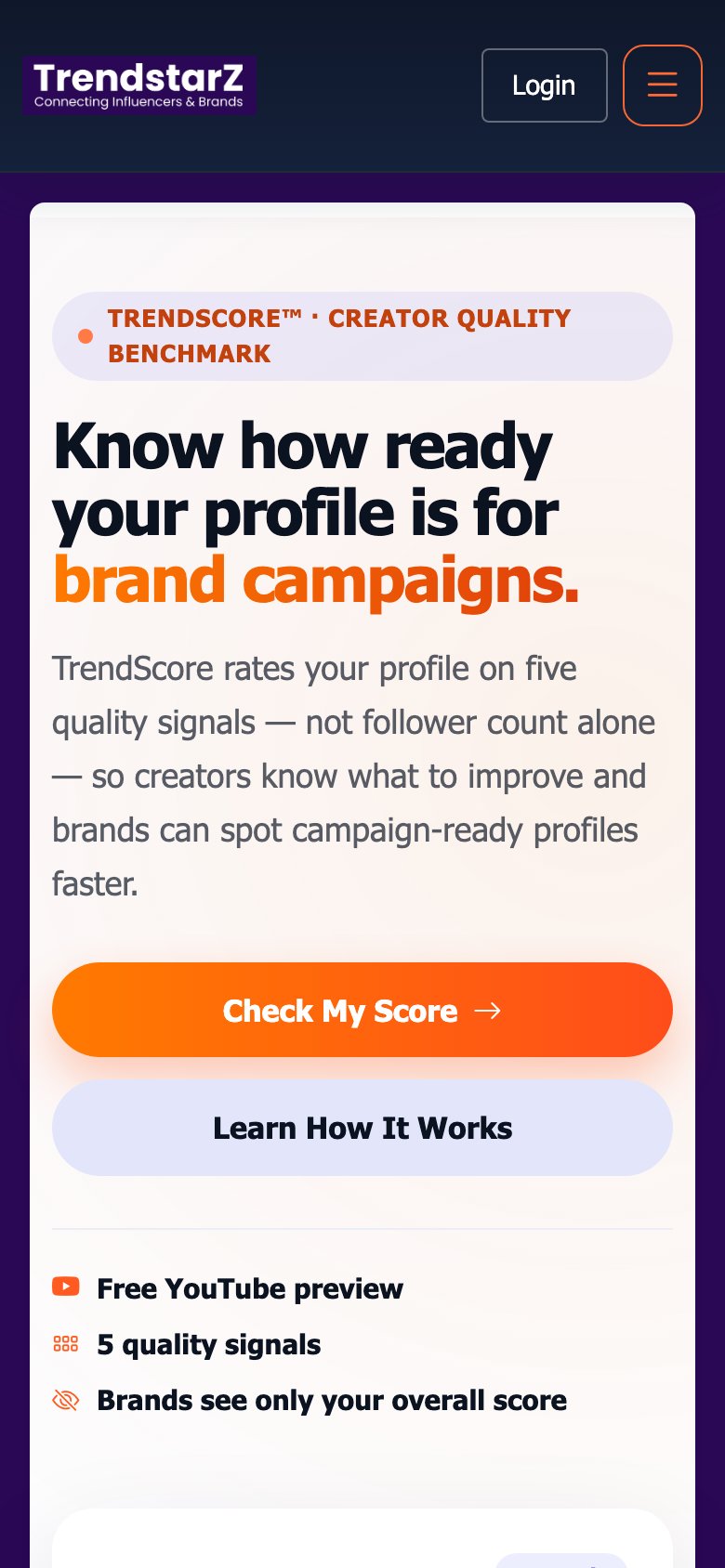
Five quality signals roll up into one score. Creators see each signal and what to work on; brands only see the overall score.

TrendScore page with a sample score of 82 out of 100 broken into five quality signals (desktop)
TrendScore page with a sample score of 82 out of 100 broken into five quality signals (mobile)
04

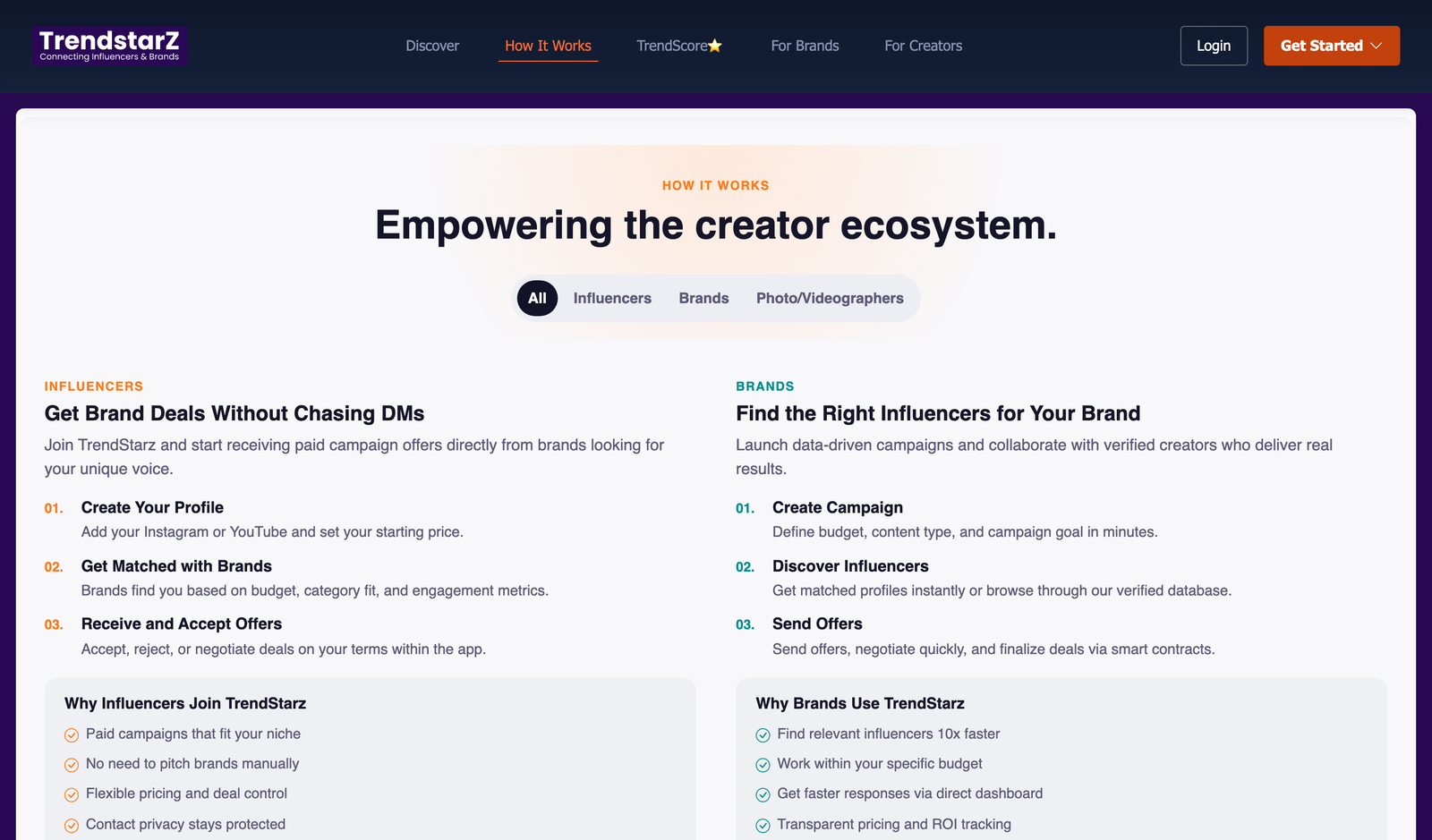
Each role's steps, side by side

One page explains how campaigns work for influencers, brands and photographers, with tabs to focus on a single role.

How It Works page showing the influencer and brand steps in two columns (desktop)
05

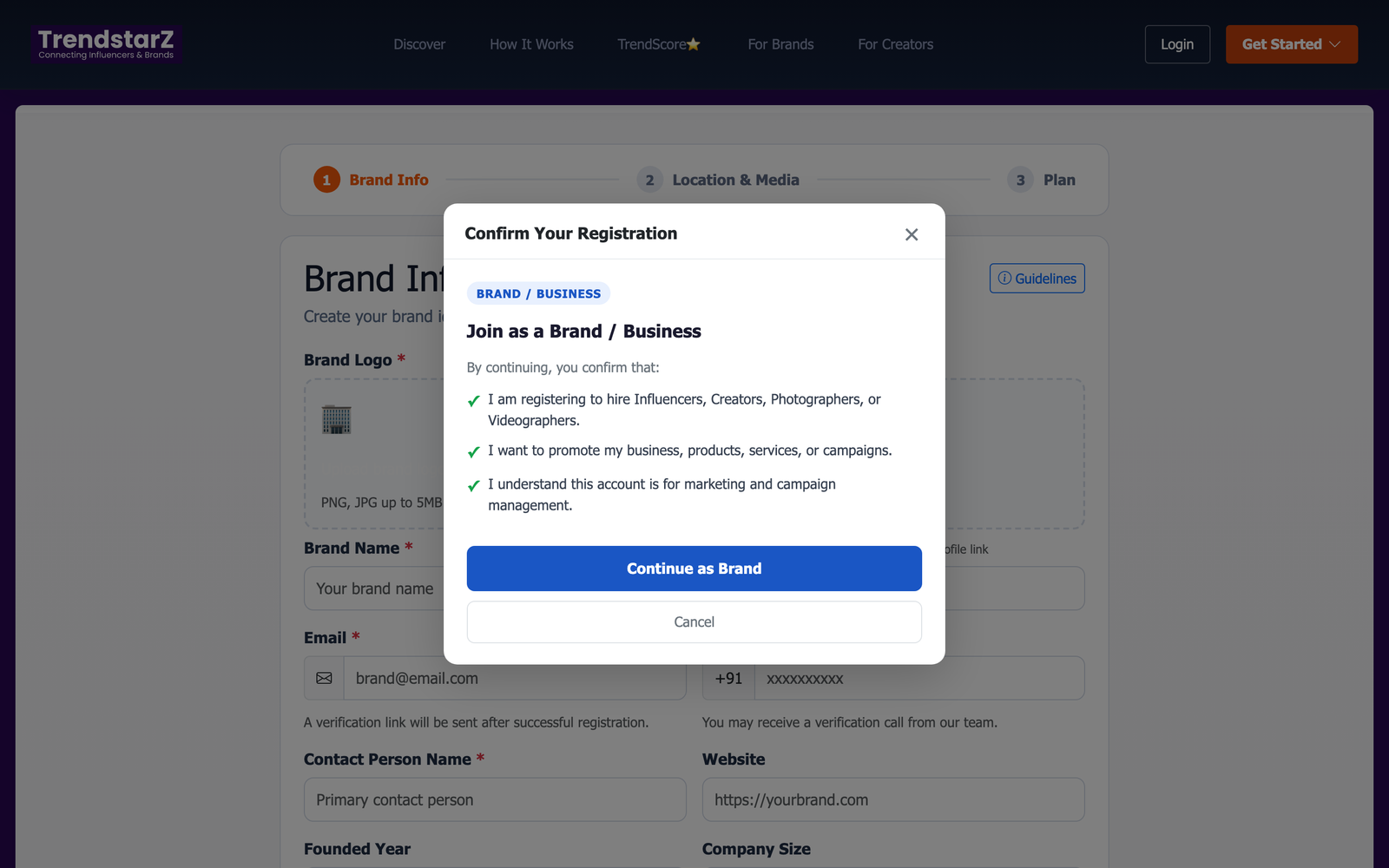
Confirm the account type first

Brand sign-up is split into three steps: brand info, location and media, then plan. A short confirmation first says what a brand account is for, so people pick the right account type before filling in the form.

Brand registration with a three-step progress bar and a dialog confirming the brand account type (desktop)

Design Rationale

Key Decisions & Why

Most decisions came from watching real users get confused or stuck, then removing the cause.

Renamed "Collaboration" to "Campaign" for every invite, with "Campaign · from a Brand / Photographer / Influencer"

WhyCreators thought a "collaboration invite" was an Instagram Collab-post request and accepted without reading the brief

Fee locked when the invite is accepted

WhyA later commission change can never change what someone already agreed to

Creators see their fee after commission

WhyThey see exactly what will reach their bank, which avoids disputes

Valid UPI ID required before accepting paid work

WhyPayouts never stall after the work is done

Posting window counted from the post date

WhySimple to explain and fair to both sides, so I kept it even when other options came up

Monthly slots per plan; no-shows still use a slot

WhyStops spam invites and makes no-shows cost something

Barter and location campaigns capped (e.g. 2 of 3 Premium slots)

WhyKeeps the marketplace focused on paid work

Platform not responsible for products or visits, only for tracking posts

WhyThe scope I can deliver reliably, stated clearly in the terms

GST at 0% until a valid GSTIN is saved

WhyMatches the business's real tax status and blocks wrong invoices

Quality

Engineering for Trust

A platform that holds other people's money has to be correct, not just working. Before growth, I ran more than 80 audit passes over money, data, security and privacy, and fixed what each one found.

Money safety

Guards stop a double payout or a double refund when two requests run at once. A payment reference can't be used twice. Razorpay payments are matched daily against the records, and overdue payouts and refunds raise alerts.

Nightly self-checks

A data-health page runs 28 checks every night, including whether payments add up, refunds are owed, links point to real records and scheduled jobs are running.

Backups that are tested

Encrypted nightly database backups are kept for 14 days. A restore is tested automatically every week.

Security

Private fields (UPI, phone, tokens) are stripped from every public response. Account lockout after repeated failed logins, two-factor login for admins, security-alert emails, and logout everywhere when a password changes. Every admin money action is logged with who did it.

Privacy

Consent is recorded at signup, users can download their own data, and account deletion is confirmed by password or an emailed code. A written retention policy decides when old records are anonymised.

Tests

1,986 backend tests (some run against a real database) and 361 frontend tests run before every release, followed by a smoke test after each deploy.

System Design

Tech Stack & Architecture

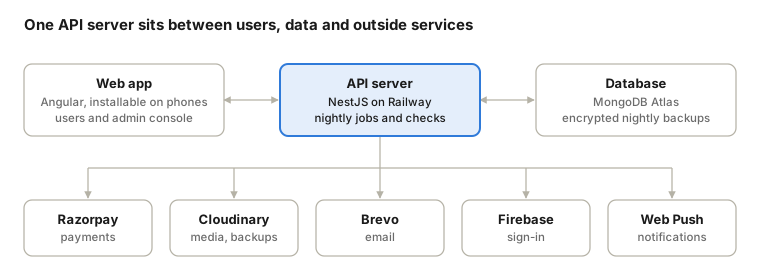
The web app talks only to the API. The API owns every rule about money and data, so no rule can be skipped by calling a service directly.

Architecture: the Angular web app talks to a NestJS API server on Railway, which connects to MongoDB Atlas and to Razorpay, Cloudinary, Brevo, Firebase and Web Push.

Scheduled jobs (payout reminders, data checks, backups, score refresh) run inside the API on India time, with locks so two servers never run the same job twice.

Impact

Results

TrendStarz is live with paid, barter and location campaigns, held payments, UPI payouts, Premium plans and a full admin console. With the foundation in place, the focus has moved from building to growth.

350+Registered creatorsInfluencers and photographers
25+Registered brands
17Campaigns completed
₹1,10,402Paid out to creators
68%On-time posting rate

Figures as of November 2026.

What's Next

  • Brand outreach and creator marketing to grow both sides of the marketplace
  • Automatic WhatsApp updates, waiting on Meta business approval
  • Premium Creator Membership launch
  • Measure how well matching works on real data before adding any AI to it

Reflection

What I Learned

Words are product decisions

One word, "collaboration", made creators misread every invite. Renaming it did more than any new feature.

Money features need more testing than anything else

Most serious bugs only appeared when two actions happened at the same moment, like a double approval or a payment arriving after a deadline. Guarding against those mattered more than adding features.

Let the system check itself

Nightly checks found problems such as stale Premium flags and a stuck refund before any user reported them.

Measure before adding AI

I held back AI matching until real usage data shows where matching actually fails.

Ready to start a project?

The platform was strategically designed with freemium and premium collaboration models in mind. UX decisions considered user acquisition, creator engagement, campaign visibility, monetization opportunities, and scalable marketplace growth.